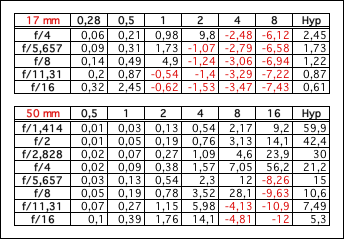

Despite some research, I never found a depth-of-field card matching my personal requirements, so I had to design one… I was looking for a quick to use table, just giving me an order of magnitude. In the field, I always end up adjusting the aperture with the depth of field test button, or by looking at the result on screen.
I will not give you a lecture on the depth of field subject, as it is fairly well explained on Wikipedia.
The acceptable cercle of confusion is often defined as the sensor's diagonal divided by 1440. This gives 0.030 mm for 24x36 mm film (or a full frame sensor) and 0.018 mm for a 15x22.5 mm APS-C sensor. For an average eye with 1 to 2 arc minutes of angular resolution, this means looking at a print from a distance of a little more than the diagonal (about 15" for a 8x11" print). That's the circle of confusion to be used when you wish to adjust depth of field for subject isolation from the background ; it's my reference.
René BOUILLOT considers that the cercle of confusion leading to maximum resolution for a specific sensor has a 2 pixels diameter; which I find optimistic considering that these pixels still need demosaicing. For the Canon EOS 5D Mark II as for the EOS 20D, this leads to a 2x0,0064 mm = 0,013 mm circle of confusion. That's the circle of confusion to be used when you wish maximum sharpness for landscapes or very large prints for instance. It just happens that it's about twice as small as the standard circle of confusion for the EOS 5D Mark II. Therefore, I just use the standard table, dividing by two the depth of field results or multiplying by two the hyperfocal results.
(For the EOS 5D Mark IV and its 2x0.00536 = 0.01 mm circle of confusion, I use a ratio of three.)
Here is the instance I use with a 0.030 mm circle of confusion: